


Trade professionals need clothing that supports the way they actually work. Electricians, builders, plumbers, installers, technicians, landscapers and maintenance crews often perform tasks requiring bending, lifting, climbing and regular movement between different environments. Well-selected work apparel should therefore prioritise function while still allowing businesses to present a consistent and professional team image.
The right wardrobe is not necessarily the heaviest or most technical one available. It is the collection of garments that best matches the tasks, climate and working conditions of each employee.
Begin With Role-Based Requirements
A large trade business may have several different roles.
Field technicians may need tool storage and durable trousers, while supervisors may spend more time meeting customers and coordinating projects.
Separate requirements into categories before ordering.
For example:
Field Workers
May prioritise:
- Durability
- Mobility
- Practical pockets
- Weather protection
- Visibility where appropriate
Supervisors
May need:
- Practical workwear
- A slightly more structured appearance
- Garments suitable for site and customer meetings
Office and Sales Staff
May prefer:
- Polos
- Button-up shirts
- Corporate trousers
- Branded jackets
Colours and logos can connect these different wardrobes.
Mobility Should Be Tested
Workers rarely stand still for eight hours.
They kneel, reach overhead, climb ladders and move equipment.
Therefore, evaluate garments through realistic movements.
Ask employees to try:
- Squatting
- Reaching
- Kneeling
- Sitting
- Climbing movements
- Lifting motions
If a garment becomes restrictive during these activities, it may not be suitable for the role.
Climate Matters
Australian working conditions can vary considerably.
A garment suited to a cool morning may become uncomfortable by midday.
For hot conditions, look for appropriate lightweight options and ventilation.
For cooler periods, build a layering system rather than relying on one extremely heavy garment.
Layering Example
A flexible wardrobe might include:
- Lightweight work shirt
- Mid-layer jumper or hoodie
- Vest
- Outer jacket
Employees can adjust clothing as conditions change.
Pockets Should Serve a Purpose
Trade clothing often includes multiple pockets, but usefulness matters more than quantity.
Consider what workers actually carry.
Examples include:
- Mobile phones
- Pens
- Tape measures
- Small tools
- Notebooks
- Keys
- Identification cards
Pocket position should allow easy access without interfering with bending or movement.
Explore Trade-Focused Clothing Ranges
Businesses can review established ranges such as Bisley Workwear when comparing garments for trade and industrial teams.
Using a coordinated range can make it easier to combine shirts, pants, shorts and outerwear while keeping the workforce visually consistent.
Select Trousers With the Job in Mind
Work trousers carry a significant amount of the daily load.
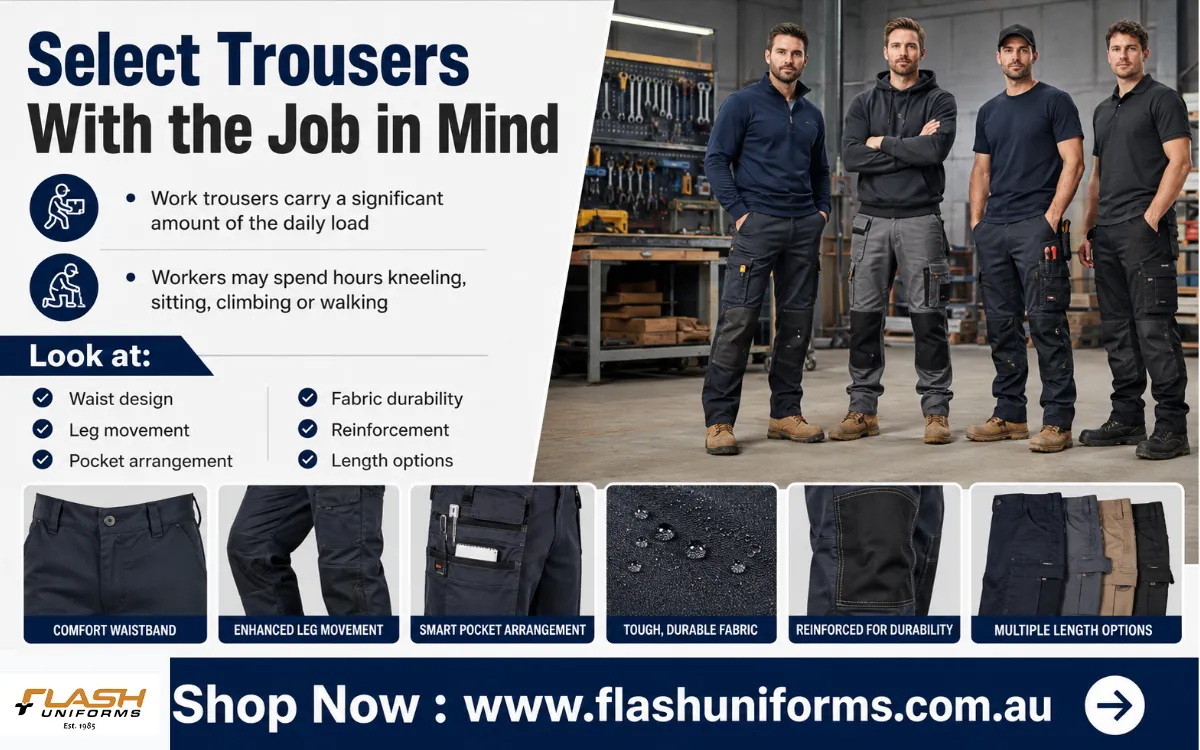
Workers may spend hours kneeling, sitting, climbing or walking.
Look at:
- Waist design
- Leg movement
- Pocket arrangement
- Fabric durability
- Reinforcement
- Length options
A trouser suited to warehouse work may not be ideal for someone regularly kneeling on rough surfaces.
Shorts Can Be Useful in Suitable Roles
During warmer periods, some workplaces permit shorts.
Where appropriate, work shorts can provide greater airflow and comfort.
However, businesses should always consider workplace hazards and internal policies before making them part of the approved wardrobe.
Work Shirts Should Balance Strength and Comfort
Shirts are one of the most visible parts of a trade uniform.
They therefore need to perform physically while also supporting the company’s professional image.
Look for suitable:
- Sleeve lengths
- Fabric weights
- Ventilation
- Collar construction
- Pocket design
- Branding areas
A clean, well-fitting work shirt can help field employees look professional when arriving at customer properties.
Branding Helps Customers Identify Your Crew
Trade employees often work in public spaces or at customer premises.
A company logo can make team members easier to recognise.
Consider consistent branding across shirts, jackets and outer layers.
If a logo is present only on the shirt underneath, it disappears whenever an employee puts on a jacket.
Planning branding across seasons prevents this problem.
Safety Requirements Come First
Where employees face specific hazards, required protective or visibility clothing should take priority over aesthetic preferences.
A company’s work apparel strategy should be integrated with its broader workplace safety processes.
Managers should assess applicable obligations for each site and role instead of assuming one uniform configuration works everywhere.
Ask Employees What Actually Works
Experienced tradespeople often know exactly which garment details make their day easier.
Ask questions such as:
- Which pockets do you use?
- Where does clothing usually wear out?
- Which areas feel restrictive?
- Do garments become too hot?
- Which layers do you use most often?
This feedback can dramatically improve purchasing decisions.
Standardise Without Becoming Inflexible
Uniform consistency is valuable, but employees do not all perform identical tasks.
Create approved options rather than one mandatory item where appropriate.
For example:
- Two approved work shirts
- Approved work trouser and short
- Two outer layers
- Role-specific safety garments
The logo and colour scheme can remain consistent.
Plan Replacements
Work apparel will eventually show signs of heavy use.
Develop a clear process for replacement.
Employees should know when and how to request new garments.
Managers can also periodically review:
- Fading
- Damage
- Broken closures
- Worn reflective elements where relevant
- Excessive stains
- Poor fit
Replacing unsuitable clothing maintains the team’s professional appearance.
Why Choose Flash Uniforms?
Flash Uniforms offers Australian trade and business customers access to clothing from multiple recognised workplace apparel brands, covering shirts, pants, shorts, outerwear and visibility-focused options. Businesses can combine practical garments with custom company branding to create a coordinated appearance across field workers and other employees. Having different product categories available also allows organisations to select garments based on job requirements rather than using one solution for every position.
Final Thoughts
Trade clothing performs best when it is selected around real work.
Comfort, mobility, climate, storage and durability are all important considerations.
Businesses should involve employees in the selection process and build a wardrobe with enough flexibility for different roles and seasons.
By balancing function with consistent colours and branding, employers can create work apparel that helps crews perform comfortably while presenting a professional image whenever they interact with customers.